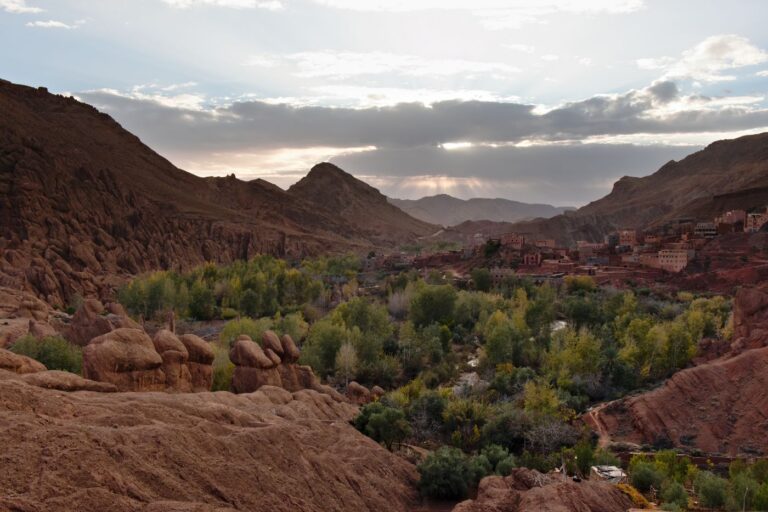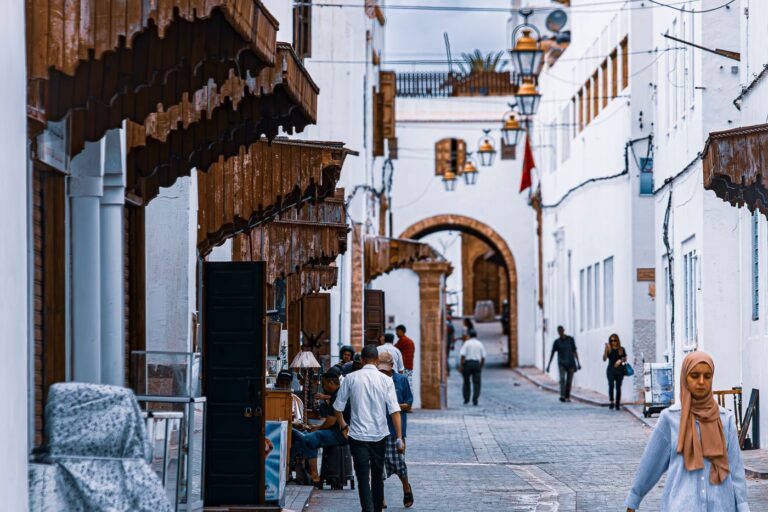

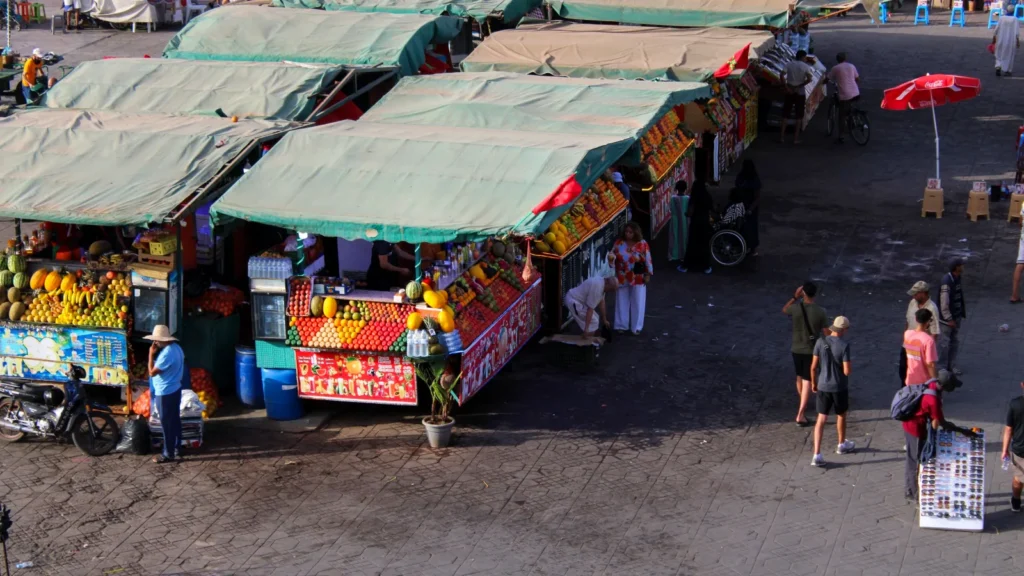
Morocco markets are not one thing. There are specialised lanes where craftsmen still hammer brass and cut leather, spice squares that smell of cumin and orange blossom, weekly rural souks where livestock changes hands, and fish markets that wind down by lunchtime. Knowing which kind you are walking into changes what you bring, when you go and how you spend.
This guide maps the most useful markets, gives timing tips, explains bargaining in plain terms, and lists the pitfalls to avoid. Details come from Rough Guides and MarHire, and the comparison below notes where prices come from a single guide, so treat them as ranges, not tariffs. For the layout of the old city around the souks, read our Marrakech medina guide first.
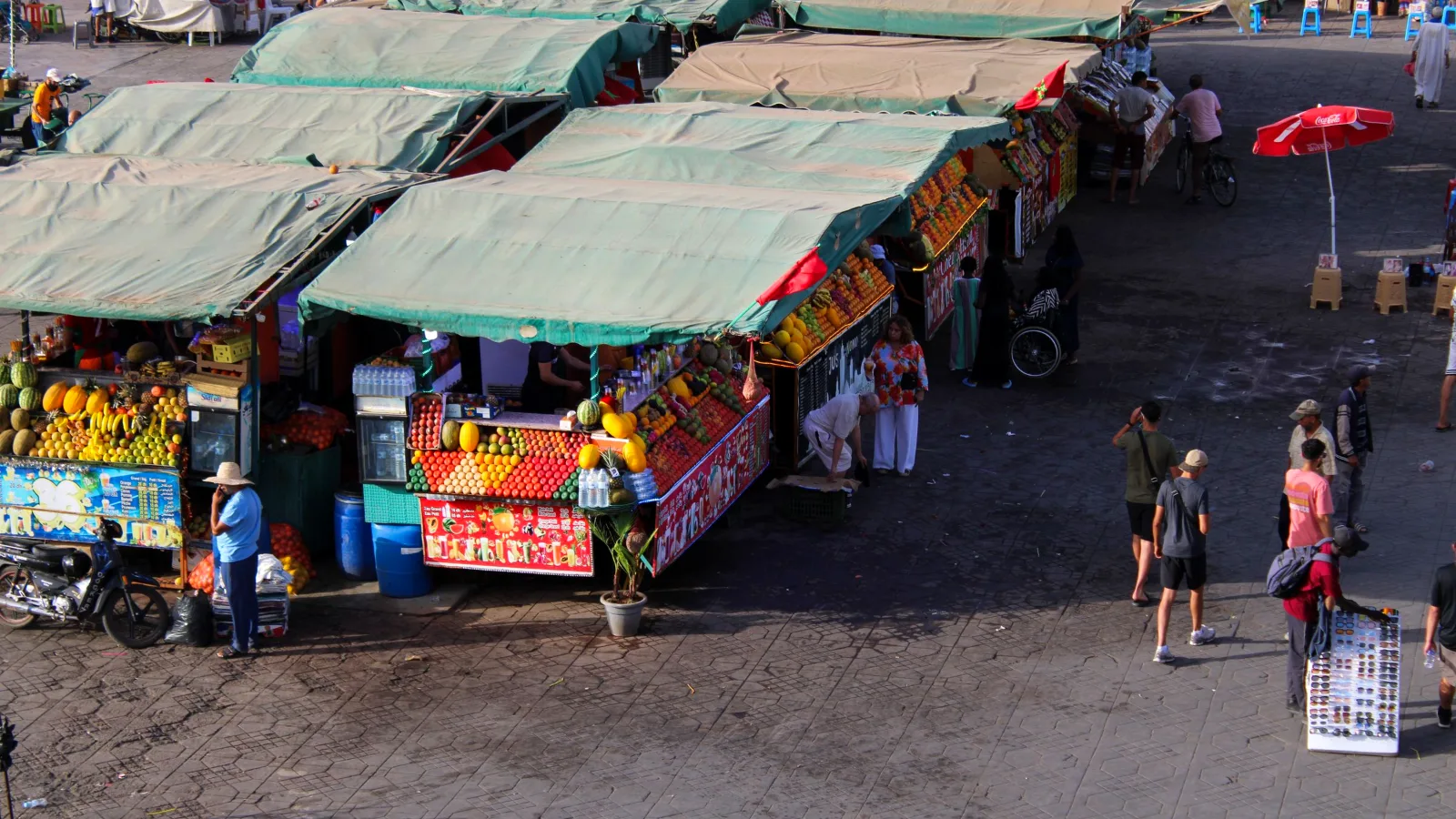
Table of Contents
Morocco markets at a glance
The table lists the markets that come up most often, with the best time to go according to the guides and what each is known for.
| Market | City or area | Known for | Best time reported |
|---|---|---|---|
| Souk Semmarine | Marrakech medina | Textiles, pottery, kaftans, carpets and jewellery | Mornings, about 9 to 11 am |
| Souk Smata | Marrakech | Babouche slippers, some made on site | About 10 am to noon |
| Souk Cherratin | Northern Marrakech medina | Leather bags, purses and wallets | About 10 am to 2 pm |
| Souk Chouari | Northern Marrakech medina | Cedar and thuya wood, carved screens and furniture | Mornings, about 9 to 11 am |
| Souk Haddadine | Northern Marrakech medina | Brass lanterns, copper trays and wrought iron | Mornings, about 9 to 11 am |
| Souk el Attarine | Fez | Spices, herbs, incense and crafts | Mornings, about 9 to 11 am |
| Essaouira fish market | Essaouira port | The day’s catch | About 7 to 9 am |
| Had Dra souk | About 30 km inland from Essaouira | Weekly rural market for livestock and produce | Sundays, 7 to 10 am |
Marrakech souks: what to look for
Marrakech has the biggest concentration of specialised souks, and the main artery is Souk Semmarine, north of the main square. Rough Guides lists it for textiles, pottery, kaftans and antiques, and notes that it also holds expensive tourist emporiums, so it is a good place to see the range but not always to buy. Branch off it and the trades separate: Smata for babouche slippers, Cherratin for leather, Chouari for cedar and thuya wood, and Haddadine for metalwork.
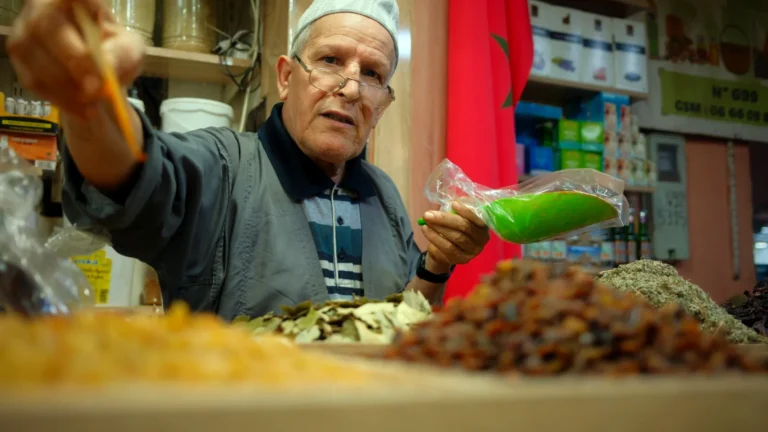
MarHire adds Rahba Kedima, a square known for spices, herbs, baskets and natural cosmetics, and the dyers’ souk, where wool and textiles hang to dry and photograph well. Several guides advise going in the morning, when the lanes are quieter and shopkeepers are in a better mood to talk. Our Marrakech attractions guide shows how to fit souk time around the main sights.
Rural markets and fish markets
Outside the big medinas, weekly souks give a very different picture. Rough Guides describes Had Dra, a Sunday-only rural market about 30 km inland from Essaouira, where sheep, goats, donkeys and camels are traded alongside produce and household goods. It is best early, between about 7 and 10 am, and is smaller in the rainy winter months. The same guide recommends the Essaouira fish market near the southern ramparts for the freshest catch, best between 7 and 9 am. Both are working markets, not tourist shops, so go to watch and eat rather than to buy souvenirs.
What to buy in Moroccan markets and typical prices
MarHire gives tourist price ranges in euros. They come from one guide only, so use them to sense-check an opening price rather than to set your offer. The same article warns that very cheap items may be lower-quality imports, machine-made or fake.
| Item | Typical tourist price (one guide) |
|---|---|
| Babouche slippers | 10 to 30 euros |
| Small leather bag | 20 to 60 euros |
| Medium lantern | 25 to 80 euros |
| Spice bundles | 5 to 20 euros |
| Argan oil | 10 to 40 euros |
| Handmade ceramics | 8 to 60 euros |
| Small rugs | 80 to 250 euros |
| Large handmade rugs | 300 to 2,000 euros or more |
How to bargain without spoiling the day
Bargaining is normal in many traditional souks, but fixed-price shops exist, especially in curated artisan boutiques. MarHire gives a clear rule of thumb: do not open too low. Its example is that offering 300 MAD against a 1,000 MAD quote can end the conversation. No fixed percentage works everywhere, so the practical approach is to start below the first price and settle at a fair middle point.
- Decide what the item is worth to you before you ask the price
- Stay friendly and patient, and never mock the craftsmanship or the price
- Do not pretend to buy something you do not want, and be ready to walk away politely
- Do not haggle hard over small amounts
- Ask the total price including shipping before agreeing to ship large items
For banknotes, change and card use, our money in Morocco guide covers the basics. MarHire notes that cash is useful and can give more room to negotiate, while larger stores may accept cards.
Scams and pressure tactics to avoid
MarHire lists the patterns that cause most complaints, and they match the advice in our safety and etiquette guide:
- Fake guides who give directions and then demand money
- “This way is closed” redirects that lead to a commission shop
- Claims that a rug is handmade, argan oil is pure or jewellery is silver when it is not
- Tea invitations that turn into long sales pitches
- Inflated shipping fees for large purchases
A polite no and a steady pace usually end a pitch. If you feel pressured, leave and come back later, or ask your accommodation to recommend a fixed-price craft shop.
Eating and resting in the markets
Markets tire you quickly, so build in breaks. Mint tea stops and market-side stalls are everywhere, and in the evening Marrakech’s main square turns into a food market: Rough Guides says stalls set up around 5 to 6 pm and are busiest from 7 to 10 pm, with communal tables. Our Morocco food guide explains what to order from the grills and soup stalls.
Morocco markets: frequently asked questions
What is the best market in Morocco?
For variety, the Marrakech souks, especially Semmarine and the specialised lanes branching from it. For a local, non-tourist experience, a weekly rural market such as Had Dra near Essaouira is the best example in the guides.
When is the best time to visit the souks?
Mornings, between about 9 and 11 am, are recommended for most of the Marrakech crafts souks. Late afternoon is another good window, and midday is hotter and more crowded.
Should I haggle in Moroccan markets?
Yes in traditional souks, politely and without opening too low. Fixed-price shops exist, so ask before you start negotiating.
How much should I pay for a rug in Morocco?
One guide quotes about 80 to 250 euros for small rugs and 300 euros or more for large handmade ones, but prices vary widely with size, age and quality. Ask for the material and whether the piece is truly handmade.
Are Moroccan markets open on Fridays?
Rough Guides lists Semmarine as open daily, with many shops opening later on Friday mornings, and several others, such as Cherratin, Chouari and Kimakhine, as open daily except Friday mornings. Plan your souk walk for another day or for the afternoon.