
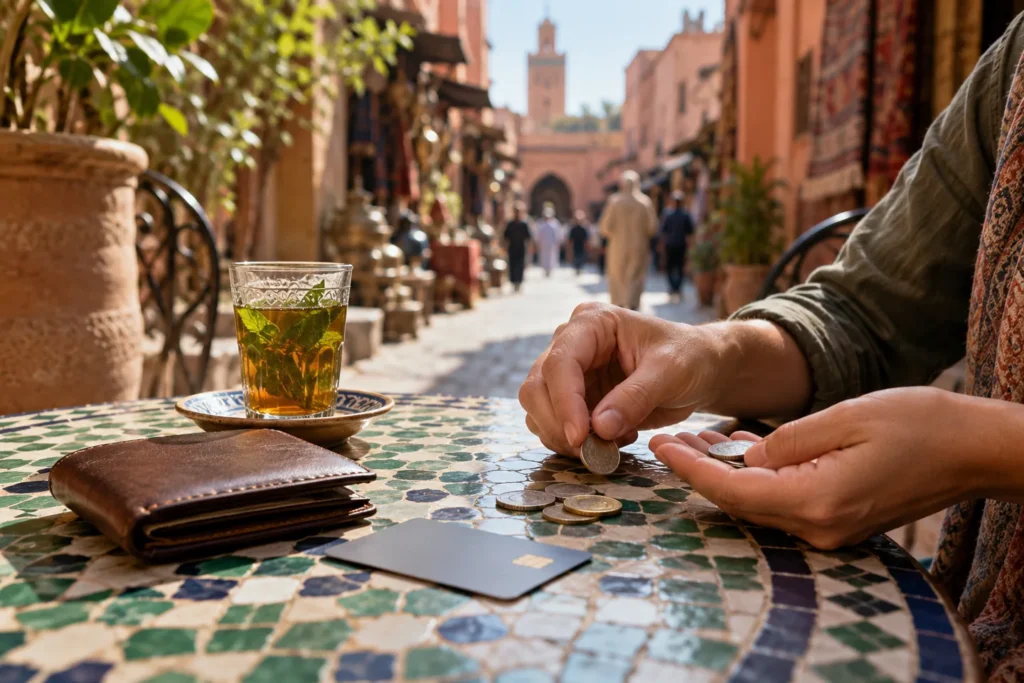
money in Morocco is easy to manage when you arrive with a simple system: one main card, one backup card and enough Moroccan dirhams for small daily purchases. This guide explains currency, ATMs, card payments, exchange offices, common fees and tipping without relying on a fixed exchange rate.
Contents
Table of Contents
Money in Morocco: the quick answer
The local currency is the Moroccan dirham, written as MAD or DH. One dirham is divided into 100 centimes. Use dirhams for normal purchases, keep small notes for taxis, cafés and markets, and carry a card for hotels, larger restaurants and other established businesses.
Do not depend on only one payment method. A practical setup is a modest cash reserve split between two safe places, a primary Visa or Mastercard and a second card stored separately. Tell your bank about the trip if required and check its foreign transaction and ATM fees before departure.
Money in Morocco: dirhams, notes and prices
Banknotes commonly used by travellers include 20, 50, 100 and 200 dirhams, while coins are useful for small purchases and tips. Vendors may struggle to change a 200-dirham note early in the day, so break large notes at supermarkets, museums or established cafés when possible.
Exchange rates move, so avoid publishing or memorising one permanent conversion. Check the current reference rate from Bank Al-Maghrib, then compare the final amount offered after commission. A small difference matters less than using a licensed, transparent counter and receiving a receipt.
Money in Morocco: cash, cards and ATMs
ATMs are widespread in Moroccan cities, and international Visa and Mastercard cards are accepted by most hotels and by some restaurants, shops and fuel stations, according to the Moroccan National Tourist Office. Acceptance is less reliable in small medina stalls, village cafés and remote areas.
Withdraw during bank opening hours when convenient, use an ATM attached to a recognised bank, shield the keypad and collect the card before walking away. Make fewer sensible withdrawals instead of many tiny ones, but never carry the entire travel budget in one wallet.
Where to exchange money in Morocco safely
Licensed exchange offices, banks and airport counters can exchange foreign cash; some hotels also offer the service. Airport exchange is convenient for arrival expenses, while city offices may offer a better final rate. Compare the displayed buy rate, commission and exact dirham total before handing over money.
Bring clean, undamaged banknotes and your passport because a counter may request identification. Keep exchange and ATM receipts until departure, especially if you might convert remaining dirhams. Never accept street exchange offers, even when the promised rate looks unusually attractive.
Avoid ATM fees and dynamic currency conversion
Your home bank, the local ATM operator or both may charge a withdrawal fee. Read every on-screen message before confirming. If a machine offers to convert the withdrawal into your home currency, choosing the dirham amount without the machine conversion usually lets your own card network set the exchange rate.
The same principle applies to card terminals: if asked whether to pay in dirhams or your home currency, review the rate and fees rather than accepting automatically. Check each total before entering a PIN, keep alerts enabled, and contact your bank promptly if a transaction looks unfamiliar.
Money in Morocco: tipping without stress
Tipping is appreciated for good service but is not a single compulsory percentage everywhere. In a café, rounding up or leaving a few dirhams is common. In a restaurant, many travellers leave about 5–10% when service is not included and the experience was good. Check the bill first.
For hotel staff, drivers and guides, consider the length and quality of the service, group size and what was already included. Keep small notes so the gesture is direct and discreet. A tip should reward helpful service, not replace a clearly agreed price for a transfer, tour or purchase.
Build a practical daily cash system
Set a daily cash amount for taxis, snacks, markets and minor admissions, then top it up as needed. Store reserve cash and the backup card separately from the day wallet. Photograph neither your card nor PIN; instead, save the international phone number for your bank in a secure place.
For a multi-city journey, estimate larger prepaid costs separately from daily spending. Review what is included in your accommodation or tour before carrying extra cash. Our Morocco tours and custom Morocco tour pages can help clarify route inclusions.
Payment safety in medinas and on road trips
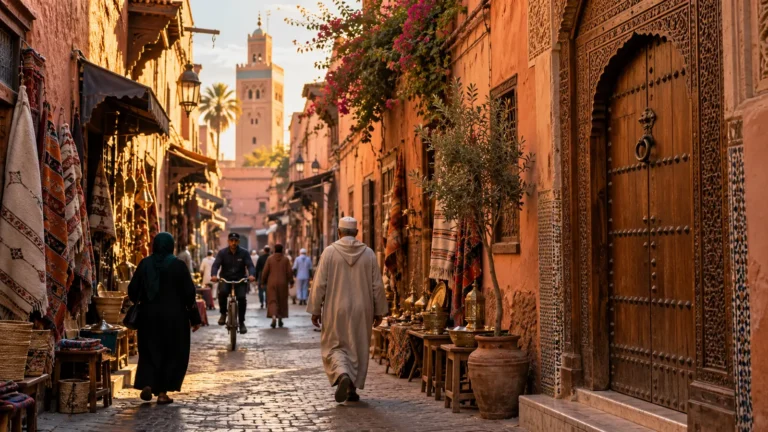
Count change calmly, confirm taxi prices or meter use before the ride, and agree on the full price before accepting a service. In busy places, take out only the money needed for the purchase. See our Morocco safety and etiquette guide for broader practical advice.
On a Morocco road trip, fill up before remote stretches and keep cash for smaller fuel stations, parking and roadside cafés. Do not assume every terminal is working. A charged phone, bank alerts and an offline record of emergency numbers provide useful backup.
Cash declarations and departure planning
Morocco’s Office des Changes states that payment instruments with a value equal to or above 100,000 dirhams must be declared to customs on entry; declaration below that threshold is optional. Special proof rules can still apply when re-exporting foreign currency, so read the current official guidance before travelling with a large amount.
Near the end of the trip, spend or exchange excess dirhams through an authorised channel and keep the receipt. Rules and banking terms can change, so verify official information and your own bank conditions close to departure rather than relying on an old screenshot or a fixed online rate.
Money checklist before your Morocco trip
- Primary card with international use enabled
- Backup card stored separately
- A small amount of arrival cash
- Bank and card emergency phone numbers
- Foreign transaction fee checked
- ATM withdrawal limit checked
- PIN memorised and payment alerts enabled
- Small notes for daily purchases and tips
- Secure second place for reserve cash
- Receipts kept for withdrawals and exchanges
- Current exchange rate checked before travel
- Official cash-declaration rules reviewed if relevant
Frequently asked questions
Should I bring cash or use a card in Morocco?
Bring both. Cards work well at many hotels and established businesses, while cash remains important for small shops, taxis, cafés, markets and rural stops.
Can I use euros or US dollars in Morocco?
Some tourism businesses may quote them, but the dirham is the normal currency for everyday payment. Convert through a licensed office or withdraw dirhams from a bank ATM.
Are ATMs easy to find in Morocco?
They are common in cities and larger towns. Withdraw before remote routes and keep a backup card because individual machines can be offline or reject a particular card.
How much should I tip in Morocco?
There is no universal rule. Round up or leave a few dirhams for small service, and consider roughly 5–10% in restaurants when service is not included and the service was good.
Final money plan
The safest approach to money in Morocco is a balanced one: use dirhams for everyday spending, cards where they are clearly accepted, and a separately stored backup. Check live rates and fees, keep receipts, carry small notes and verify official rules before travelling with significant cash.