
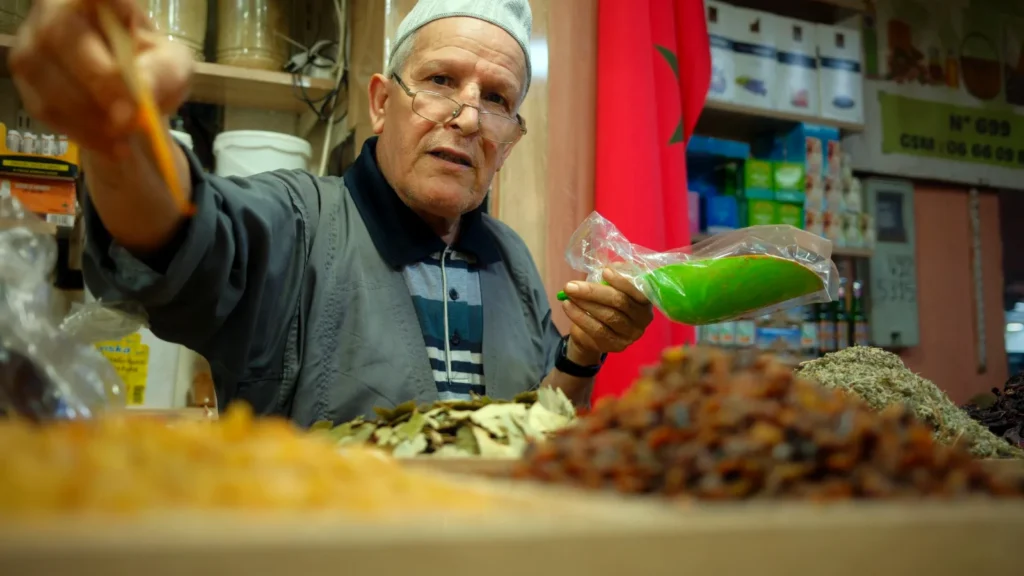
Marrakech souk bargaining is easier when you treat it as a calm conversation, not a contest. In traditional market stalls, many prices are flexible, but the goal is a fair amount that both buyer and seller can accept. This guide gives you useful Darija phrases, a practical price method, and the etiquette that keeps the exchange friendly.
Table of Contents
Marrakech souk bargaining: the quick answer
Ask the price, compare a few similar stalls, make a realistic counteroffer, and increase your offer in small steps. Smile, stay unhurried, and only bargain for an item you may genuinely buy. If the final price does not suit your budget, thank the seller and leave politely. There is no universal percentage because quality, materials, workmanship and the seller’s starting price vary widely.
Bring small Moroccan-dirham notes and decide your maximum before the conversation begins. Our money in Morocco guide explains cash, cards and change, while the Morocco safety and etiquette guide covers everyday courtesy in busy medinas.
Where bargaining is normal—and where it is not
Marrakech souk bargaining is common for crafts, textiles, leather goods, lamps, ceramics, jewellery and some souvenirs in traditional souks. It is usually inappropriate in supermarkets, pharmacies, restaurants, museum shops, modern boutiques and any shop displaying a clear fixed-price policy. Food stalls may have set local prices even when signs are absent, so ask before assuming.
- Usually negotiable: one-off craft purchases and several items bought together.
- Sometimes negotiable: higher-value goods where size, material or workmanship differs.
- Usually fixed: menus, transport tickets, medicines, entrance fees and labelled retail goods.
The Moroccan National Tourist Office’s Marrakech shopping overview describes the city’s craft souks and specialist market areas. Use it to understand what is sold where, then judge each transaction on its own merits.
12 useful Darija phrases for a Marrakech souk
| Darija phrase | Approximate meaning | When to use it |
|---|---|---|
| Salam | Hello | Open every conversation politely |
| Shukran | Thank you | After help or before leaving |
| Bshhal hada? | How much is this? | Ask for the first price |
| Ghali shwiya | It is a little expensive | Signal that you want to negotiate |
| Nqes shwiya, afak | Lower it a little, please | Make a courteous request |
| Akher taman? | Final price? | Ask when you are close to agreement |
| Ana ghadi nshuf | I am going to look around | Pause and compare |
| Ma ‘andish ktr mn… | I do not have more than… | State a genuine budget ceiling |
| Wakha | Okay | Accept clearly |
| La, shukran | No, thank you | Decline without conflict |
| Baraka Allah fik | Thank you / blessings to you | End warmly |
| Bslama | Goodbye | Close the exchange |
Pronunciation varies and sellers may also speak French, English or Spanish. A friendly attempt matters more than perfect Darija. Never imitate an accent for comic effect, and switch languages if communication becomes confusing.
A simple five-step bargaining method
1. Look before you negotiate
Browse several stalls and inspect comparable quality. A hand-knotted textile, machine-made souvenir and antique piece cannot be valued with the same rule. Ask about material, origin, dimensions and whether the item is handmade. For expensive objects, take time to verify claims instead of relying on urgency.
2. Set a private maximum
Choose the most you would happily pay before making an offer. Your ceiling should reflect value to you, not a rumour about the “local price.” Keep that number private and leave room for two or three small moves.
3. Make a serious opening offer
An extremely low offer can end the conversation or turn it into theatre. Start below your ceiling but within a range you can defend. If the seller’s first price seems unrealistic, ask questions or compare elsewhere before countering.
4. Move slowly
Increase your offer in small, clear steps. Do not bargain against yourself by immediately raising the price after silence. Bundling two items may produce a better total, but confirm the combined price and exact pieces before paying.
5. Accept or leave graciously
Once both sides agree, complete the purchase; reopening the price after a clear agreement is poor etiquette. If you cannot agree, say “la, shukran” and walk away calmly. A seller may call out a lower price, but you are not obliged to return.
Opening offers and price anchors
For Marrakech souk bargaining, you will often see advice telling visitors to offer a fixed fraction of the first price. That shortcut is unreliable. Some opening prices are close to fair, others are optimistic, and quality differences can be substantial. A better anchor is your comparison of similar items, materials and workmanship.
If you have not compared anything, say you are browsing and return later. For a low-cost souvenir, the time spent chasing the last few dirhams may not be worthwhile. For a carpet, jewellery piece or large leather item, slow down, request details and do not let tea or hospitality create an obligation to buy.
How to walk away politely
A polite exit is part of good Marrakech souk bargaining etiquette. Thank the seller, return the item carefully and say that the price is above your budget. Do not criticise the craft, laugh at the offer or accuse the seller of cheating simply because you disagree. If you feel pressured, move into a busier lane and continue your visit.
Plan your route so you are not shopping while rushing to a tour or reservation. Our things to do in Marrakech guide helps place souk time around major sights without turning the market into a hurried checklist.
Common mistakes and scams to avoid
- Negotiating without intent to buy: browsing is fine, but extended bargaining signals real interest.
- Forgetting the currency: confirm whether a quoted number is dirhams and calculate before agreeing.
- Changing the item: keep sight of the exact piece, especially when it is wrapped.
- Believing urgent stories: “last day,” “family price” or “antique” are not proof of value.
- Following an unsolicited guide: directions or introductions may lead to commission-based shops.
- Paying before checking: inspect seams, zips, chips, measurements and contents first.
- Showing a large wallet: organise small notes separately and count change calmly.
Sample Marrakech souk bargaining dialogue
You: Salam. Bshhal hada? (Hello. How much is this?)
Seller: 450 dirhams.
You: Ghali shwiya. Nqes shwiya, afak? (A little expensive. Lower it a little, please?)
Seller: 380.
You: I compared similar lamps. I can offer 300.
Seller: 350, final.
You: I can do 330 and pay now.
Seller: Wakha.
You: Shukran.
This dialogue is a model, not a price guide. Substitute a number that matches the real item and your research. Keep your tone light and be prepared for either answer.
Frequently asked questions
Is Marrakech souk bargaining rude?
No, it is expected in many traditional souk transactions. It becomes rude when the tone is disrespectful, the offer is deliberately insulting or the buyer agrees and then refuses the deal.
How much should I reduce the first price?
For Marrakech souk bargaining, there is no safe universal percentage. Compare similar goods, inspect quality, set a budget and negotiate from evidence rather than a fixed formula.
Can I pay by card in the souks?
Some larger shops accept cards, but many small stalls prefer cash. Confirm the payment method and total before agreeing, and keep enough small dirham notes for change.
Final etiquette checklist
- Greet first and ask permission before photographing a person or stall.
- Compare quality rather than chasing a mythical percentage.
- Use small, clear counteroffers and keep your maximum private.
- Do not accept tea, wrapping or demonstrations as a purchase obligation.
- Check the exact item and count change before leaving.
- After agreement, pay the agreed price without restarting the negotiation.
- If there is no agreement, thank the seller and leave calmly.
Good Marrakech souk bargaining protects your budget without stripping the exchange of its human side. A few Darija phrases, realistic comparisons and a respectful exit will take you further than aggressive tactics—and make the market more enjoyable for everyone.