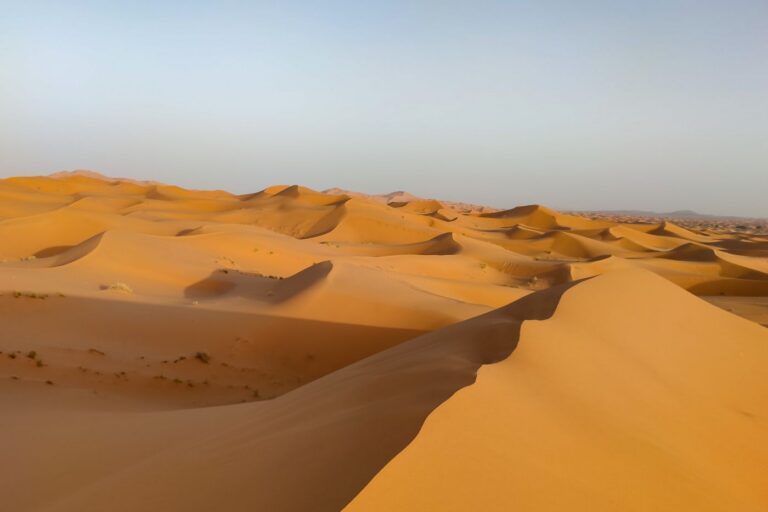

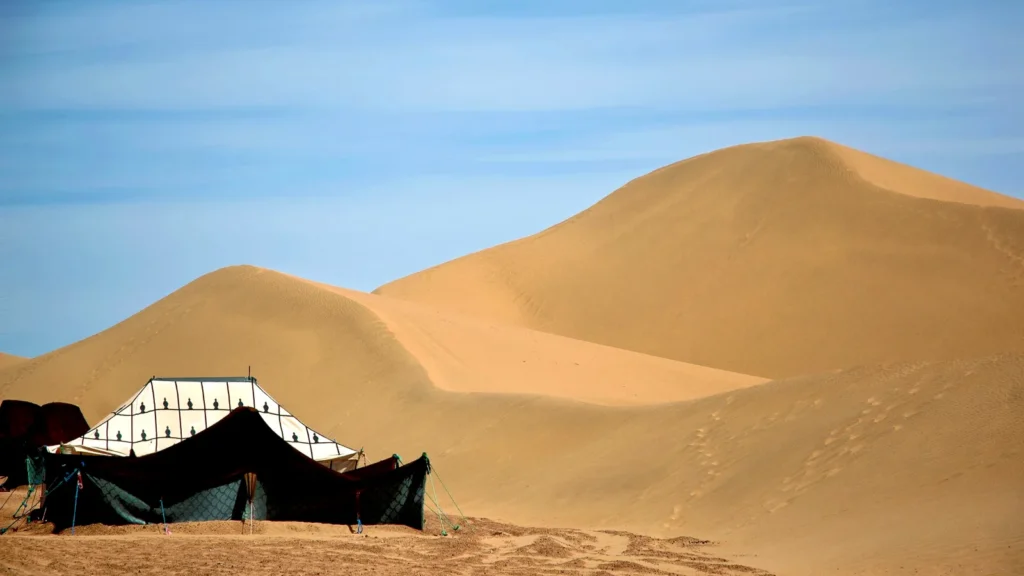
Desert camping in Morocco usually means a night in a tent camp among the dunes, reached by camel or 4×4, with dinner around a fire and a sky with very little light pollution. The reality ranges from basic Berber tents to camps with beds, hot showers and proper bathrooms, and the right choice depends on how far you are willing to drive and how much comfort you want.
This guide covers the two main dune areas, Erg Chebbi near Merzouga and Erg Chigaga near M’Hamid, when to go, what the camps are like, what to pack and how to plan the drive. Sources are Culture Trip and Malika in Morocco; the second is a personal blog with affiliate links and the sources give no camp prices, so I do not quote any. The two also disagree on some drive times, which I flag below.
Table of Contents
Desert camping in Morocco: Erg Chebbi or Erg Chigaga?
| Erg Chebbi (Merzouga) | Erg Chigaga (M’Hamid) | |
|---|---|---|
| Distance from Marrakech | 556 km, listed as 8.5+ hours (text says about 9) | 445 km, listed as 7+ hours (text says about 9) |
| From Fez | About 7 hours to Merzouga | Not stated |
| Dunes | Up to 150 m | Lower than Chebbi, no height given |
| Access | Easy; tours from Ouarzazate or overnight from Fez | Final stretch unpaved; 4×4 and a local driver advised |
| Atmosphere | More developed and busier | Quieter, fewer visitors |
| Camps | Many, budget to luxury; many have electricity and hot showers | Fewer, with a simpler, eco-focused, unplugged style |
| Best for | First-timers and anyone wanting convenience | Adventurous travellers wanting solitude |
The drive times conflict inside the Malika in Morocco article itself, so treat all of them as rough and confirm with your operator. Our Marrakech to Merzouga trip guide shows how the drive is usually split.
What a desert camp is actually like
According to Culture Trip, the experience typically centres on a camel trek to the campsite, a night in a tent, and sunset and sunrise from a dune. The author calls the camel ride a highlight but notes it can be uncomfortable on uneven dunes. Higher-end camps offer basics such as toilets, while many have no electricity, so you cannot rely on charging your phone, and the camps are remote with no mobile reception.
Malika in Morocco adds that Erg Chebbi camps range from budget to luxury, many with electricity and hot showers, and that some host drumming sessions. Chigaga has fewer camps and leans towards simple, unplugged stays. Camp quality varies enormously, so ask exactly what is included: bed type, bathroom, power, dinner and breakfast.
Best time for desert camping in Morocco
| Season | What the source says |
|---|---|
| April, May, September, October | Recommended months (Culture Trip) |
| July and August | Many luxury camps close; temperatures can exceed 50°C according to the source |
| Winter | Comfortable days, but nights can fall to about 10°C |
The 50°C figure is Culture Trip’s own claim, and I did not verify it against a climate record, so treat it as indicative. For wider seasonal planning see our best time to visit Morocco guide.
A typical camp night, step by step
Two sources describe the rhythm of a night. Adventure Life (a luxury-camp article, so read it as a best case) says tours start in gateway towns such as Merzouga or Zagora, then guests travel by 4×4 or camel caravan into the dunes, watch the sunset turn the sand gold, orange and deep red, eat dinner in a dining area, and gather around a central fire. It says local hosts may perform Berber drumming and music, though that is not guaranteed.
A first-hand account from There She Goes Again gives actual timings for a June stay. The author left the guesthouse around 6 pm, watched the sunset from a dune around 7:30 pm and reached camp around 8:30 pm, roughly 2.5 hours with stops. Mint tea, cookies and nuts came on arrival, dinner was served around 9:30 pm, and breakfast included a Berber omelette. The author found the staged campfire singing touristy and preferred stargazing, which is a useful warning if you want a quiet night.
- Expect a sunset arrival, an evening meal and an early start the next morning
- Camp evenings may include drumming; you can usually step away to look at the stars
- Camel getting-on and getting-off is the awkward part, and loose long trousers help since there are no stirrups (one traveller’s account)
- Some travellers return by jeep instead of camel, which the same author found easier on the body
What to pack for a night in the desert
- Extra warm layers, even if you sleep inside a tent, because nights are cold
- A sun hat and UV-protective sunglasses
- Closed-toe shoes for camel treks
- Long trousers, which help with the saddle and the sun
- A power bank, since many camps have no electricity
Our Sahara desert tour packing list goes into more detail.
How long to plan for
Culture Trip suggests at least two days in the desert, with one night in a camp and one in a lodge at the edge of the dunes, because travel from Marrakech or Fez is long. It also warns that cheap group tours from Marrakech may use vehicles without air conditioning, which the author says is hard to tolerate on long drives. If you want a shorter, closer option, our Agafay desert guide covers the rocky desert near Marrakech, which is a different landscape from the sand dunes of the Sahara.
Activities around a desert camp
Beyond the camel trek, Culture Trip mentions sandboarding and palm grove picnics that can be arranged. Our sand surfing guide covers the dune-sliding side, and our Fes to Marrakech desert tour guide covers a classic overland route that includes a camp night.
Camp types and what to ask before you book
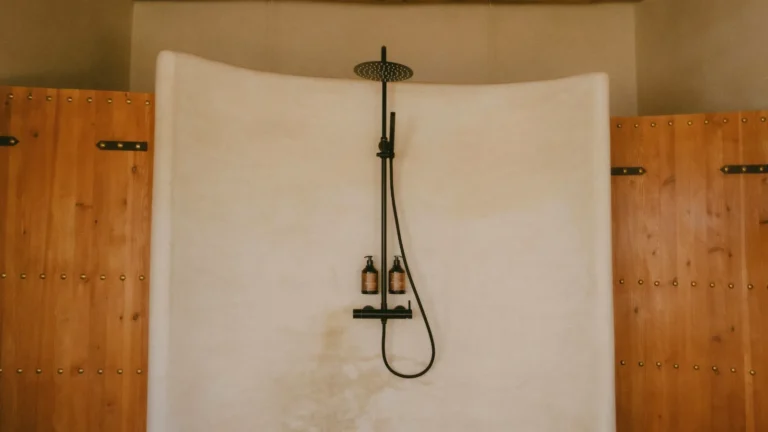
Sources describe a wide range. Adventure Life describes the top end as spacious private tents with real beds, good linens, private bathrooms (inside the tent at some camps), solar lighting, charging points and, at many camps, air conditioning in warmer months. The first-hand account describes a more modest camp with a main dining tent and sleeping tents either side, a fire pit and hammocks, where the power went out for a few hours in the night and Wi-Fi was patchy.
The same traveller paid 700 MAD per person (about 72 US dollars) for a luxury camp and 450 MAD (about 46 US dollars) for a budget camp, booked through a guesthouse. That is a single data point from one June stay, not a price list, so treat it as an example only. The budget gap may be worth paying for, but ask first.
| Ask the operator | Why it matters |
|---|---|
| Is there a bed, and what bedding? | Basic tents may offer mats or simple mattresses |
| Is the bathroom private, and where? | Inside the tent versus a nearby shared area |
| Is there power or charging? | Many camps have none; others use solar |
| What is included? | Dinner, breakfast, camel ride, transfers |
| Is there heating or cooling? | Nights can be cold in winter and hot in summer |
| Can I skip the group entertainment? | Drumming and singing are common but not for everyone |
Desert camping in Morocco: frequently asked questions
Where is the best place for desert camping in Morocco?
Erg Chebbi near Merzouga is easiest and has the most camps. Erg Chigaga near M’Hamid is quieter but needs a 4×4 on the final unpaved stretch.
When is the best time for desert camping in Morocco?
April, May, September and October are recommended. Many luxury camps close in July and August, and winter nights can drop to about 10°C.
Do desert camps have electricity and showers?
It varies. Many Erg Chebbi camps have electricity and hot showers, while Culture Trip warns that many camps have no electricity and no reception, so confirm before you book.
How many days do I need?
At least two days in the desert is suggested, because the drive from Marrakech or Fez is long.
How cold does it get at night?
In winter nights can fall to about 10°C according to Culture Trip, so bring warm layers even if you sleep in a tent.
Related guides
- Camel Rides in Marrakech Morocco: Prices and Options
- Morocco Hiking Tours: 10 Best Trails and Planning Tips
- Morocco Fishing: Best Spots, Seasons and Permits
- Morocco Valley of Roses: Season, Festival, Visit Tips
- Three Valleys Morocco: Which Valleys and What to Expect
- Talassemtane National Park Morocco: Hikes and Facts