
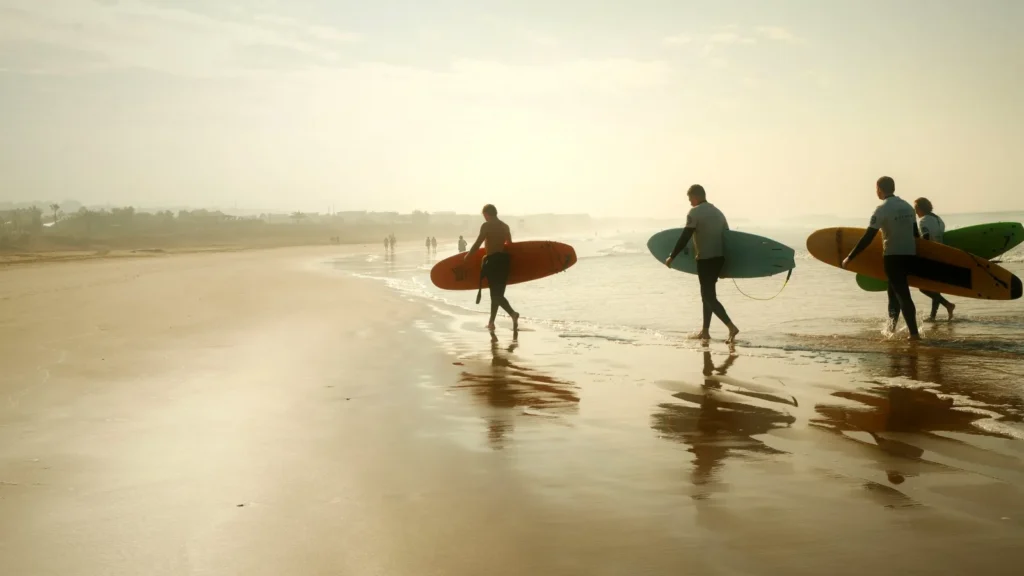
Surf lessons in Morocco are easy to find on the Atlantic coast, but not all lessons are equal. The useful questions are where the school teaches, how many students are in the water, whether the instructor is qualified and what happens if the waves are not suitable.
This guide covers the main learning areas, the difference between group and private lessons, what a beginner session usually includes, and a checklist for choosing a school. Details differ by operator, so confirm anything that matters before you pay.
Table of Contents
Where to take surf lessons in Morocco
| Area | Why beginners go there | Notes |
|---|---|---|
| Taghazout and Tamraght (north of Agadir) | Many schools and several sandy beach breaks within a short drive | Busy in peak season; choose schools that cap group size |
| Agadir | Wide beach and easy transfers from the airport and city hotels | Gentler surf in smaller conditions; check the day’s waves |
| Imsouane | Long, slow-breaking waves suit learners and longboarders | Small village; further from the main airports |
| Essaouira and Sidi Kaouki | A different, windier coast with a laid-back feel | Wind can limit lessons; ask about alternatives |
| Rabat and Casablanca | Urban surf scene and local schools | Smaller scene than the south; conditions vary |
For a trip built around learning, Taghazout, Tamraght and Agadir are the simplest choices because they combine lessons, accommodation and transport in one area. Our Agadir guide covers the city and nearby coast.
Group lessons or private lessons?
| Option | Best for | Trade-off |
|---|---|---|
| Group lesson | Social learners and tighter budgets | Less individual feedback; ask for a maximum group size |
| Semi-private lesson | Friends or families who want shared coaching | Pace depends on the weakest surfer |
| Private lesson | Nervous beginners, children and anyone who wants fast feedback | Usually costs more |
A smaller group is not always better if the instructor is inexperienced, so check the group size and the instructor’s qualifications together, not separately.
What a beginner lesson usually includes
- A short warm-up and a beach briefing on safety, paddling and how to stand up.
- Time in the water, often around one to two hours, with hands-on help and feedback.
- A board and wetsuit, which are usually provided; confirm this in advance.
- Waves chosen for the day by the instructor, not by you.
Transport, photos and equipment you keep after the lesson are not standard; ask before booking. Lessons depend on conditions, so a good school will offer another date or a refund if the surf is unsuitable.
Questions to ask before you book
| Question | What a good answer sounds like |
|---|---|
| Who is the instructor, and are they certified? | A named instructor with recognised surf and water-safety qualifications |
| How many students per instructor? | A clear maximum, ideally small for complete beginners |
| Is equipment included and suitable for beginners? | A soft-top board and a wetsuit that fits |
| Where is the lesson held? | A named beach suited to learners, not a point break |
| What happens if conditions are poor? | Rebooking or refund, in writing |
| Do I need to be able to swim? | A clear yes or no answer; comfortable swimming is strongly advisable |
Season, weather and fitness
Beginners often find spring, early autumn and summer easier, because waves are usually smaller. Winter swell is bigger and more powerful, and some beaches are too rough for lessons on many days. Check the marine forecast from the official Moroccan weather service and ask your school how they judge conditions. Our Morocco weather in June guide shows how the summer months feel on the coast.
Surfing is tiring. You need to be able to swim, tolerate cold water and paddle repeatedly. If you have a medical condition, a back or shoulder problem, or you are pregnant, speak to a doctor first and tell the school. Check your travel insurance covers surfing.
Common mistakes
- Choosing the cheapest lesson without asking about group size or qualifications.
- Booking a single lesson and expecting to stand on every wave.
- Skipping sun protection; UV is high even in cooler months.
- Arriving without a plan for a rest day, since surfing is physically demanding.
Surf lessons in Morocco: questions answered
Where is the best place for beginner surf lessons in Morocco?
Taghazout, Tamraght and Agadir are the most popular areas because they have many schools and sandy beach breaks. Imsouane is also well known for gentle, long waves.
How many lessons does a beginner need?
Most people want several sessions to build confidence. A single lesson can introduce the basics, but progress varies from person to person.
Do I need to bring my own equipment?
Usually not. Most beginner lessons provide a board and a wetsuit, but confirm what is included.
Is it safe for children?
Many schools teach children, often with private or semi-private lessons. Ask about minimum age, supervision and the conditions on the day.
Choosing the right lesson
Pick the area first, then the format, then check the instructor, group size and weather policy. A good school will answer these questions clearly and plan around conditions. For other ways to fill your days on the coast, see our things to do in Morocco guide and how many days in Morocco for planning a longer route.