
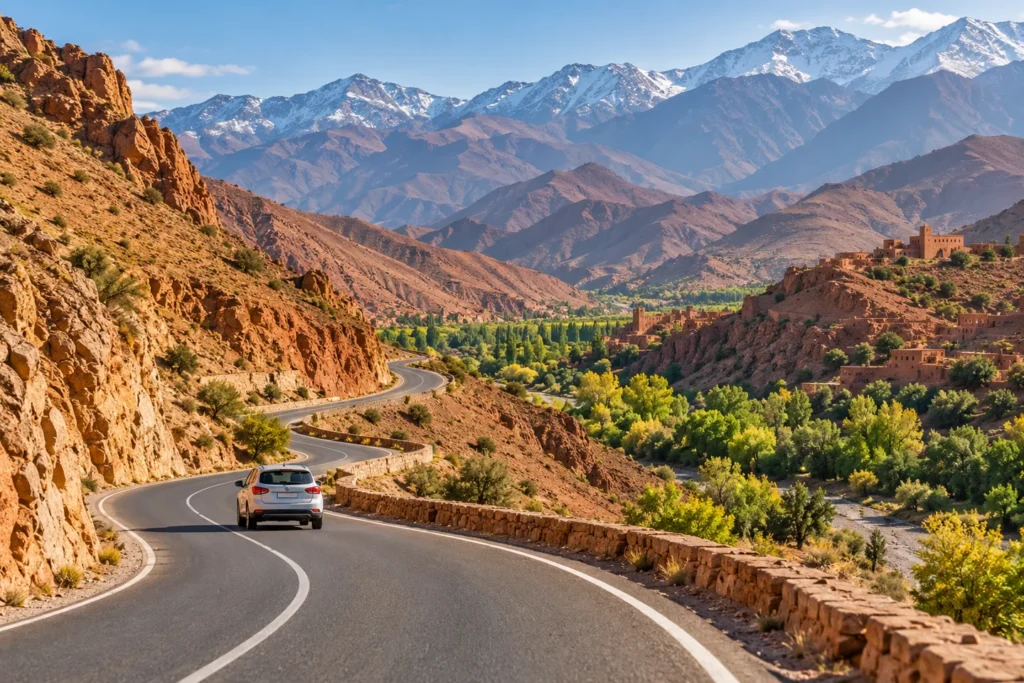
A Morocco road trip gives you the freedom to stop at oasis towns, mountain passes and coastal villages, but distances are long and driving conditions are very different from most of Europe or North America. Planning around realistic times, correct paperwork and sensible daylight hours makes the difference between a memorable trip and a stressful one.
These 20 driving tips combine official advice from the UK Foreign Office and Australia’s Smartraveller with practical planning rules. Official advice changes, so check the current pages before you leave.
Table of Contents
Morocco road trip: quick answer
Rent a car if you are confident on mountain roads and happy to avoid night driving; hire a private driver if you would rather watch the scenery. Either way, keep road days moderate, build a buffer before flights and carry your documents at all times.
| Choice | Best for | Main trade-off |
|---|---|---|
| Self-drive | Confident drivers who want flexibility | Paperwork, parking and long days behind the wheel are your responsibility |
| Private driver | Families, first-time visitors, mountain and desert stages | Less spontaneity and a higher cost per day |
| Mixed | Drive the coast, hire a driver for the Atlas and desert | Needs a little more planning |
Tips 1–6: documents and rules
- 1. Carry the right licence. The UK advice says to carry the 1968 International Driving Permit with your UK licence, and Smartraveller says Australians need an IDP obtained before leaving. Check what applies to your own country.
- 2. Bring proof of insurance. The UK advice says you need a green card from your insurer and must show insurance when entering and leaving with your own vehicle. For a rental, confirm what the policy covers.
- 3. Leave in the same vehicle you entered with. If you bring your own car, the authorities record your registration number on entry, and leaving in a different vehicle can lead to detention.
- 4. Keep an accident report form. After an accident both parties sign a “constat amiable”; Smartraveller suggests carrying a blank one, plus a traffic cone and a reflective vest.
- 5. Expect checkpoints. They are common, so keep your passport or ID, licence and vehicle papers within reach.
- 6. Never drink and drive. The UK advice warns of fines and possible imprisonment.
Tips 7–13: planning the road days
- 7. Avoid night driving on rural roads. Both advisories flag it as a particular hazard; plan to arrive before dark.
- 8. Respect the mountains. Mountain roads in poor weather are dangerous, and heavy rain can cause flash floods; do not drive through floodwater.
- 9. Watch for overloaded trucks. The UK advice specifically mentions overloaded lorries on motorways, so keep distance and overtake with care.
- 10. Use realistic times. As planning ranges, Casablanca to Fes is roughly three to four hours, Fes to Merzouga seven to eight hours with stops, Merzouga to Dades about five and Dades to Marrakech six or more. Weather, roadworks and stops change every day.
- 11. Keep road days moderate. One very long day followed by a light one works better than three long days in a row; see how many days to spend in Morocco.
- 12. Build a buffer before flights. Do not schedule an early flight the morning after a long mountain crossing.
- 13. Compare routes by useful time, not kilometres. A short distance on the map can take much longer on mountain roads.
Our 10-day Morocco itinerary shows how these rules turn into a route.
Tips 14–20: cities, parking, cash and help
- 14. Park outside the medina. Most medina lanes are too narrow for cars; ask your riad where to leave the vehicle safely.
- 15. Ask about guarded parking. Theft from vehicles is a risk in busy areas, so do not leave valuables visible.
- 16. Fill up before long stretches. Top up the tank before the desert and mountain sections rather than relying on the next station.
- 17. Carry some cash for tolls and fuel. Motorways are toll roads, and small stations may prefer cash.
- 18. Download offline maps. Signal can drop in mountains and desert areas.
- 19. Check what your insurance covers. Smartraveller notes that insurance may not cover motorbike or quad use, so confirm before adding those activities.
- 20. Use a driver where it makes sense. For the High Atlas and desert stages many travelers choose a private driver and drive the easier sections themselves.
Safety and etiquette on the road
Use official taxis in cities, stay alert on motorbike-heavy roads and drive defensively, as the official advice recommends. For wider guidance on scams, dress and local rules, read our guide to Morocco safety and etiquette, and read the UK Foreign Office and Smartraveller pages before you set out.
Morocco road trip: frequently asked questions
Is it safe to drive in Morocco?
Many visitors do, but both governments flag night driving, mountain roads in bad weather and heavy trucks as hazards. Keep days short, avoid driving after dark and carry your documents.
Do I need an International Driving Permit?
The UK and Australian advice both say you do, in the form the official pages specify. Check the rules for your own country before travelling.
Should I rent a car or hire a driver?
Rent a car if you are confident on mountain roads; hire a driver for the Atlas and desert if you would rather not drive them. A mix is common.
How long should a road day be?
Keep most days to a few hours of driving with a stop every two hours or so, and allow for one long day at a time.